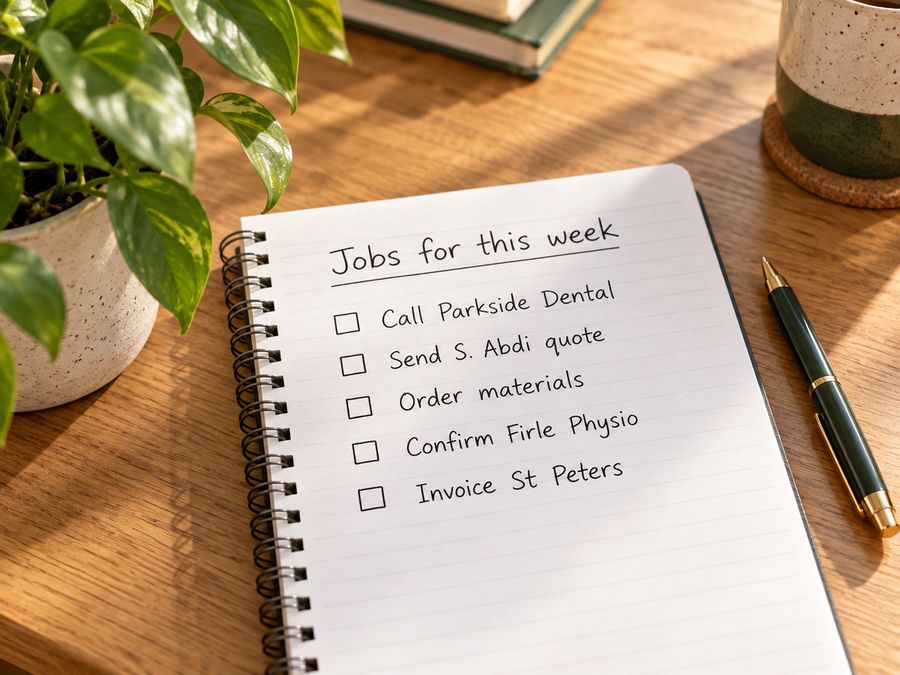
Start with the whiteboard
Bring the jobs into one shared view.

From the first quote to the final payment, see what needs to move.
Marino and Sons Plumbing · Four crews
Move jobs forward with a clear view of what’s next.
Know what is waiting, who owns it and what happens next.
Try it: open a job to see its next step, or move it along. Nothing you do here is saved beyond this visit.
And no crew leaves for a job that is not ready.
The sprint delivers personal software: durable, shaped around the client's own files and vocabulary, with visible errors and a manual fallback to Step 1. Built in their accounts.
Two booked days a month, decided each quarter on the numbers.
| When | Event | Handled |
|---|---|---|
| Daily 4 pm | Readiness check on tomorrow | 2 of 9 jobs flagged, office fixes both |
| Daily | Promised-date reminders | To crews, the evening before |
| On completion | Invoice trigger | Draft invoice in the accounting file, office sends |
| Monthly | Knockbacks: count and top three reasons | One line to the owner |
Illustrative month. The retainer is booked days, not a support arrangement.
Bring the jobs into one shared view.

Connect quotes, prepare the Monday view and check readiness.

Add reminders, invoice triggers and flags for declined quotes.
Later stages shown as concepts.
Less chasing. More getting on with it.
A simpler way to keep work moving.
This is the shape, not a result. Every worked example is a fictional business with invented numbers. See the other six examples.